
I know I'll get in trouble with this posting unless a qualifier is added in, so here it is: I'm not seriously suggesting the LXX should be adopted by modern Christians, and I am writing somewhat "tongue in cheek"... though the issues are real enough despite that.
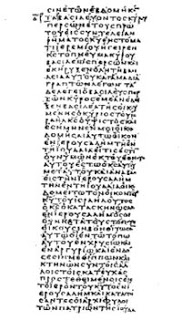
It's always puzzled me that conservative Christians get all strident about the Masoretic text of the Old Testament, when it's clear that the New Testament writers wouldn't go near the thing. Instead they used the Septuagint (LXX) almost exclusively.
There are differences between the two, and for a long time it was assumed that the LXX was an inferior product, deviating from the Hebrew original. If so, how come the early church relied on it so completely?
Then along came the Dead Sea Scrolls, and it turns out that the LXX readings do in fact go back to the Hebrew. It seems that there were variant versions of the Hebrew scriptures, one set of which underlie the Masoretic tradition, so beloved of King James fanatics, and another which leads to the LXX.
It's discoveries like these - and the scholarship that flows from them - that forever renders the old-style "Bible helps" of a previous era redundant and misleading. That news doesn't seem to have yet percolated down to the fundamentalist subculture.
Assuming you're not able to read Greek, where would you go to check out the LXX text? There have been translations, but they tend to date back to the nineteenth century, which limits both their readability and their accuracy. Mind you, if you're one of the many Rip Van Winkles who still thinks Strong's is a valuable resource, that probably won't faze you.
If not, then there's good news. Oxford University Press is scheduled to release a new LXX English translation within a few months. Even better news, you can download a pre-publication version here.
Yeah, yeah, I can hear the gainsayers already. Why bother, mythology, yadda yadda. I'm not suggesting it be put to literalist proof-texting uses, or made the object of devotional navel gazing. On the contrary, neither practice seems particularly valuable to me for any Bible version. But it does open up a new window on the historical and literary issues which - and I guess this is my point - preclude the kind of mindlessness that's rife in the splinters, the genetically modified contemporary WCG, and the evangelical community generally.
Jewish folk would also probably be pleased to have ownership of their scriptures - rooted in the Masoretic tradition - back again. The misuse and appropriation of the Tanakh has served to create tension between the two communities for centuries.
The Septuagint is the Bible of the early church, no question. It's "apostolic" in the sense that the New Testament writers quoted it almost exclusively. To paraphrase the song "Gimme that ol' time religion", if it was good enough for Paul, Matthew, Mark, Luke and John, how come it's not good enough for Spanky, Six-pack, Big Dave, Dave the Visionary, and the Cincinnati Sanhedrin? Somebody might ask these many COG gurus with pretensions to apostolic principles (Rod Meredith uses the a-word habitually) if they'll be dumping their NKJVs and moving across to the new translation...
And if not, why not?