
If anyone ever got a rough deal in the Bible it was Saul.
You know the story. Saul is a young, tall dude from the tribe of Benjamin who sets off after some missing asses and has the misfortune to catch the jaundiced but roving eye of the prophet Samuel. Before he knows it, Samuel has him oiled up as king (1 Sam. 10:1). But Saul has a self esteem problem, clearly not your typical despot, and he hides! Too bad he didn't flee to Egypt, he'd have avoided a lot of strife.
Samuel was the Roderick C. Meredith of his age: he just didn't know when to retire. After crowning Saul he didn't go off on an extended vacation and let the young king settle in. Samuel had his hands locked on the steering wheel of state, and he wasn't about to let go.
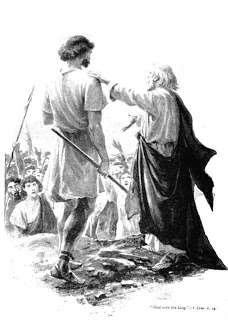
Which brings us to 1 Samuel 13. The prophet has told Saul to gather his army and wait seven days, then the Presiding Evangelist will make a grand entrance, perform a sacrifice, and the Israelites will have a glorious victory at the expense of their enemies.
Time passes, seven days in fact. No sign of Samuel. The troops are starting to slip away. They know that you can't possibly go into battle without an auspicious sacrifice: no Samuel, no sacrifice, no victory. What's worse, the enemy has already gathered and they're ready to rumble. Saul is beside himself, what can he do?
Well obviously, he's the king, so he does what David will later do (2 Sam. 6:17), he gathers up the sacred steak knives and performs the sacrifice himself.
Uh oh, here comes Samuel, and he's definitely looking unhappy.
So now the tantrum. Why didn't you (Saul) obey the Eternal's commandment?
Why? Well actually I did. I waited seven days just like you asked bub, but you dragged your feet while the army started to desert. What would you have liked me to have done? And anyway, who says it was the Eternal's command? You gave me the instruction - you never said nuthin' about Yahweh back in chapter 10 verse 8.
Of course, that's not how Saul actually responds. He's too nice a guy, overawed by the haggard old seer and, frankly, not given to the level of smooth deceit or guile that his usurper, David, will be able to drool off at the drop of a tin dagger. Saul is no politician.
And this is the beginning of the end for Saul. He's rejected. Tough break. It doesn't seem to occur to him that Samuel might need to meet with a little accident (big funeral, nice tribute, problem solved.) Duplicity isn't in his nature.
Hey wait, you say, what about chapter 15?
That's the focus of Part 2.



 with this puzzler:
 , a classic text which does indeed mention Apollonius. But to suggest that Jesus
 , and it's no surprise if his Jesus also seems skewed by wishful dogma.

 . Westminster John Knox, 1993.
 . Fortress Press, 2003.